In the bustling boardrooms of American corporations, from Silicon Valley tech giants to Midwestern manufacturing mainstays, a quiet revolution is underway. It’s not about a new product line or a disruptive business model; it’s about a fundamental shift in how companies perceive their most valuable asset: data. A recent study by the MIT Center for Digital Business found that organizations driven by data-driven decision-making (DDD) are, on average, 5% more productive and 6% more profitable than their competitors. In the hyper-competitive US market, that percentage is the difference between industry leadership and obsolescence.
Yet, a persistent challenge remains. While over 90% of business leaders agree that data and analytics are key to their digital transformation, a significant number struggle to articulate a clear, financial return on their investments (ROI). Data initiatives—from hiring data scientists to implementing enterprise-grade Customer Data Platforms (CDPs)—often fall into the category of “necessary costs” rather than strategic investments with measurable returns. This creates a “multi-trillion dollar blind spot,” where billions are spent without a clear understanding of the value generated.
This article is designed to be your guide out of that blind spot. We will demystify the process of calculating the ROI of data and analytics. More importantly, we will provide a robust framework for justifying these investments to the most skeptical of CFOs, ensuring that your organization doesn’t just collect data, but leverages it to drive tangible, bottom-line growth in the US market.
Part 1: Deconstructing Data ROI – More Than Just Dollars
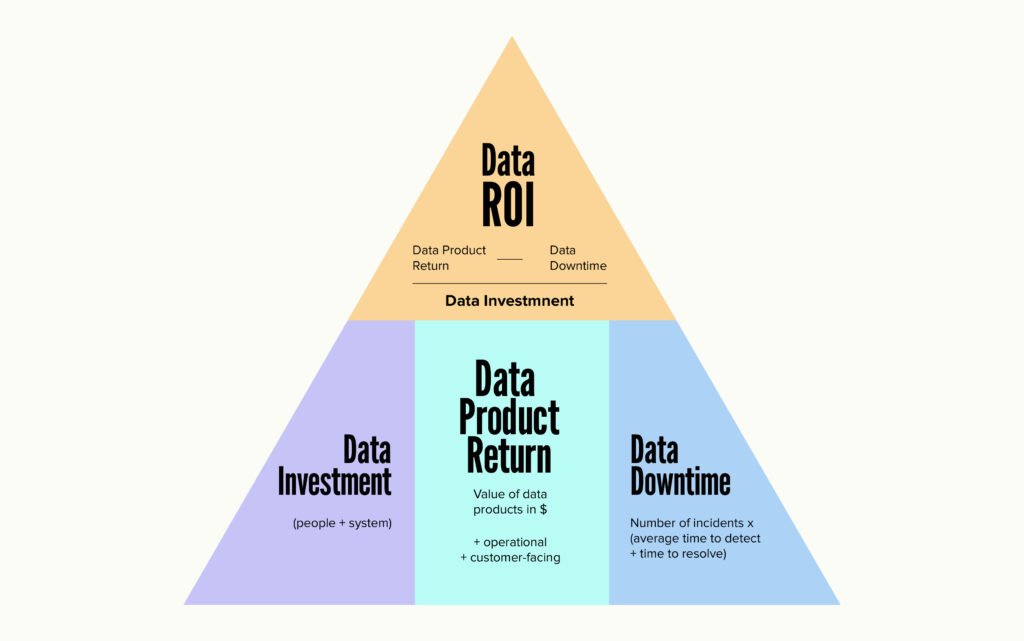
Before we can measure it, we must define it. The Return on Investment (ROI) for data is not a single, monolithic number. It’s a multi-layered concept that encompasses financial, operational, and strategic returns.
The Classic Financial ROI Formula
At its most basic, ROI is a financial metric calculated as:
ROI (%) = (Net Benefits from Investment – Cost of Investment) / Cost of Investment * 100
For a data project, this translates to:
- Net Benefits: The total financial gain attributable to the initiative (e.g., increased revenue, reduced costs, risk mitigation).
- Cost of Investment: The total cost of ownership, including software licenses, hardware, personnel (data engineers, analysts, scientists), training, and consulting fees.
While this formula is essential, it’s often insufficient on its own. A myopic focus on immediate financial returns can lead to undervaluing foundational data projects that enable future innovation.
The Three Pillars of Modern Data ROI
A more holistic view breaks down data ROI into three interconnected pillars:
- Financial ROI (The “What”): The direct impact on the P&L statement. This is the language of the CFO and is non-negotiable for securing budget.
- Examples: Increased sales conversion rates, reduced customer churn, lower customer acquisition costs (CAC), optimized supply chain logistics saving fuel and inventory costs.
- Operational ROI (The “How”): The improvements in efficiency, productivity, and process optimization. While these often translate into financial gains, they are valuable metrics in their own right.
- Examples: Reduction in manual reporting time (e.g., from 40 hours per week to 2 hours), faster time-to-market for new products, automated fraud detection reducing manual review workload.
- Strategic ROI (The “Why”): The long-term, often qualitative, benefits that strengthen the company’s competitive position. This is the most difficult to quantify but is arguably the most important.
- Examples: Improved customer satisfaction and loyalty, enhanced brand reputation as a “data-smart” company, ability to enter new markets based on predictive insights, fostering a culture of evidence-based decision-making.
The US Market Nuance: In the US, where shareholder value and quarterly results are intensely scrutinized, Financial ROI is paramount. However, the most successful American companies—think Amazon, Netflix, or Procter & Gamble—excelled by also mastering Operational and Strategic ROI, using data to build insurmountable competitive moats.
Part 2: A Practical Framework for Measuring Data ROI
Moving from theory to practice requires a disciplined, step-by-step approach. The following framework can be applied to any data analytics initiative, from a simple dashboard to a complex machine learning model.
Step 1: Establish a Clear Baseline
You cannot measure improvement if you don’t know your starting point. Before implementing any new tool or process, document the current state.
- Financial Baseline: What is the current conversion rate? What is the current CAC? What are the operational costs of the process you’re trying to improve?
- Operational Baseline: How many person-hours are spent on manual data collection and reporting? What is the current error rate in these reports?
- Strategic Baseline: What are your current customer satisfaction scores (NPS, CSAT)? What is the current time-to-insight for key business questions?
Step 2: Define Specific, Measurable Goals
Tie your data initiative directly to a business KPI (Key Performance Indicator). Vague goals like “get better insights” are impossible to measure. Instead, use the SMART framework (Specific, Measurable, Achievable, Relevant, Time-bound).
- Bad Goal: “Use analytics to improve marketing.”
- Good Goal: “Increase online sales conversion rate from the current baseline of 2.1% to 2.6% within six months by implementing a personalized product recommendation engine.”
Step 3: Isolate the Impact of Your Data Initiative
This is the most challenging part of the calculation. If sales increase, was it due to the new analytics model, a successful marketing campaign, or a seasonal uptick? Use these methods to isolate the effect:
- Controlled Experiments (A/B Testing): The gold standard. Run a pilot for one segment (e.g., show personalized recommendations to 50% of users) while maintaining the old experience for the other 50%. The difference in conversion is the direct impact.
- Pre/Post Analysis: Compare the KPI before and after implementation, while controlling for other major known factors (e.g., “We had a similar holiday season last year without the tool, and sales were X% lower.”).
- Correlation Analysis: While not proof of causation, strong correlation over time, supported by logical business reasoning, can be a powerful indicator.
Step 4: Calculate the Tangible Financial Value
Now, translate the isolated impact into dollars and cents.
- For Revenue-Generating Projects: (Attributed Increase in Conversion Rate) * (Average Order Value) * (Total Number of Visitors) = Value Generated.
- For Cost-Saving Projects: (Hours Saved per Week) * (Number of Employees) * (Fully Loaded Hourly Rate) + (Reduction in Operational Waste) = Value Generated.
Step 5: Calculate the Total Cost of Ownership (TCO)
Be exhaustive here. Hidden costs derail ROI calculations.
- Direct Costs: Software subscription/licenses, hardware/cloud infrastructure.
- Personnel Costs: Salaries, benefits, and bonuses for the team dedicated to the project (implementation, management, analysis).
- Indirect Costs: Training time for end-users, ongoing maintenance, cost of change management.
Step 6: Perform the ROI Calculation and Track Over Time
Plug the numbers into the formula.
Example: Personalization Engine for a US E-commerce Retailer
- Baseline: Monthly online revenue = $5,000,000; Conversion Rate = 2.1%.
- Goal: Increase conversion rate to 2.6% in 6 months.
- Cost of Investment (1 Year TCO):
- Personalization Software License: $120,000/yr
- Data Engineer & Analyst Time (25% allocation): $80,000
- Total Cost: $200,000
- Value Generated (After 6 Months):
- New Conversion Rate: 2.6% (a 0.5% point increase).
- Monthly Traffic: 1,000,000 visitors.
- Additional Conversions per Month: 1,000,000 * 0.5% = 5,000.
- Average Order Value: $100.
- Additional Monthly Revenue: 5,000 * $100 = $500,000.
- Annualized Revenue Impact: $500,000 * 12 = $6,000,000 (Assuming the lift is sustained).
- ROI Calculation:
- Net Benefit = $6,000,000 – $200,000 = $5,800,000
- ROI = ($5,800,000 / $200,000) * 100 = 2,900%
This staggering ROI is not uncommon for well-executed data projects. Even with a conservative estimate and accounting for gross margin, the return is compelling.
Part 3: The Art of the Business Case: Justifying Your Investment
A brilliant ROI calculation is useless if you can’t secure funding. Justifying a data analytics investment requires speaking the language of your audience and building an ironclad business case.
1. Speak the Language of Your Stakeholders
- For the CFO: Focus on Financial ROI, risk reduction, and payback period. Use their terminology: NPV (Net Present Value), IRR (Internal Rate of Return), and clearly outline the TCO.
- For the CEO/Board: Connect the investment to strategic priorities: competitive advantage, market share growth, and long-term valuation. Tell a story of how data will future-proof the business.
- For the Head of Marketing/Sales: Focus on specific use cases: “This CDP will allow us to increase lead quality by 20% and reduce CAC by 15% by targeting lookalike audiences.”
- For the Head of Operations: Emphasize efficiency gains, error reduction, and process automation. “This supply chain analytics platform will reduce inventory carrying costs by 8% and improve on-time delivery to 99%.”
2. Build a Phased, Incremental Roadmap
Avoid the “boil the ocean” approach. Propose a pilot program or a minimum viable product (MVP) with a smaller, initial investment.
- Phase 1 (Months 1-3): Pilot the personalization engine on the product page only. Budget: $50,000. Goal: Prove a 0.2% conversion lift.
- Phase 2 (Months 4-9): Roll out to the entire site and email campaigns. Budget: $100,000.
- Phase 3 (Months 10-12): Integrate with mobile app and advanced segmentation. Budget: $50,000.
This de-risks the investment and creates quick wins that build momentum and trust.
3. Quantify the Cost of Inaction
This is a powerful but often overlooked tactic. What will it cost the company not to make this investment?
- “If we do nothing, and our main competitor implements a similar system, we project a 5% loss in market share, which equates to $10M in lost annual revenue.”
- “By continuing with manual reporting, we are incurring $250,000 per year in unnecessary labor costs and risking decisions based on outdated information.”
4. Showcase Industry Benchmarks and Case Studies
Leverage the experience of others. Citing reputable research from firms like Gartner, McKinsey, or Forrester that demonstrates the average ROI for similar projects in your industry adds tremendous authority. Use anonymized case studies from your software vendor to show tangible results achieved by peers.
Part 4: Common Pitfalls and How to Avoid Them
Even with the best plans, data ROI initiatives can fail. Awareness of these pitfalls is your first line of defense.
- Focusing Only on Technology: Buying a tool is not a strategy. The biggest ROI killer is investing in a powerful platform without a team skilled to use it and a culture ready to act on its insights. Solution: Budget equally for technology, people, and process change.
- Poor Data Quality and Governance: “Garbage in, garbage out.” An analytics model built on inconsistent, dirty data will produce unreliable results, destroying trust and any chance of positive ROI. Solution: Invest in data governance from the start. Establish clear data ownership, quality standards, and a single source of truth.
- Lack of Organizational Adoption: If the end-users—the marketers, sales reps, and operators—don’t trust or understand the new dashboards and tools, they will revert to their old ways. Solution: Involve end-users in the design process. Provide comprehensive, role-based training. Demonstrate early wins.
- Treating Data as a Project, Not a Product: Data initiatives should not have a defined “end date.” They require continuous iteration, improvement, and funding. Solution: Frame your data assets as products that serve internal “customers.” Establish a center of excellence or a dedicated data team to manage its lifecycle.
Read more: Finding Value in a Growth-Stocked Market: A Screen for Undervalued US Mid-Caps
Part 5: The Future-Proof Data Strategy: Building a Data-Driven Culture
Ultimately, the highest ROI comes not from a single project, but from embedding data into the DNA of your organization. This is the strategic ROI that compounds over time.
A data-driven culture is one where:
- Decisions are challenged with “What does the data say?” rather than “I think…”
- Experimentation is encouraged, and failure is seen as a learning opportunity.
- Data literacy is a core competency for every employee, not just the data team.
- Data is accessible and democratized, with secure self-service analytics tools available to business users.
Building this culture is a long-term journey, but every successful, measurable data project is a stepping stone that demonstrates value and builds the case for a deeper, more transformative investment.
Conclusion: From Cost Center to Competitive Advantage
In the 21st-century US economy, data is not merely a byproduct of business—it is the bedrock. Viewing analytics spending as a cost to be minimized is a relic of a bygone era. The modern, winning approach is to treat it as a strategic investment in capability, efficiency, and insight.
By adopting the disciplined framework outlined in this article—defining a holistic view of ROI, measuring impact rigorously, and building a compelling business case—you can shift the conversation. You can move data from the shadows of the IT budget into the spotlight of corporate strategy, where it belongs. The goal is not just to calculate ROI, but to engineer it, creating a virtuous cycle where every dollar invested in understanding your customers, optimizing your operations, and de-risking your future generates many more in return. In the relentless pursuit of American market leadership, that is the ultimate edge.
Read more: The US Infrastructure Boom: An Equity Playplay for the Next Decade
Frequently Asked Questions (FAQ)
Q1: What is a “good” ROI for a data analytics project?
There’s no universal number, as it varies by industry, company size, and project risk. However, due to the high leverage of software and data, successful projects often see ROIs well above 100%. A foundational data governance project might have a lower direct financial ROI (e.g., 50-100%) but is essential for enabling future projects with 500%+ ROI. The key is to ensure the ROI significantly exceeds your company’s hurdle rate for other capital investments.
Q2: How do I measure the ROI of a foundational project like data governance or a data warehouse?
These projects are “enablers.” Their ROI is measured indirectly through the downstream projects they unlock and the costs they prevent.
- Efficiency Gains: Calculate the time saved by analysts and engineers who no longer have to hunt for and clean data.
- Risk Mitigation: Estimate the cost of a potential compliance fine (e.g., GDPR, CCPA) that is avoided due to proper data management.
- Opportunity Enablement: Track the ROI of subsequent projects (e.g., a new marketing analytics dashboard) and attribute a portion of their success and accelerated time-to-market to the foundational data platform.
Q3: We’re a small-to-midsize business (SMB). Are these ROI principles relevant to us?
Absolutely. In many ways, ROI is even more critical for SMBs where budgets are tighter. The principles are the same, but the scale and tools differ. Start small with a focused use case. For example, using a cost-effective BI tool like Microsoft Power BI or Tableau to analyze sales data and identify your most profitable customer segments can have a massive ROI without a massive investment. The key is to start with a specific, high-impact business question.
Q4: How long does it typically take to see a positive ROI from a data analytics investment?
This depends on the project’s complexity. A simple dashboard automating manual reports can show a positive ROI in a matter of weeks. A more complex initiative, like implementing an enterprise-wide ERP with advanced analytics, may take 12-24 months to show a full return. This is why a phased roadmap with quick wins is crucial for maintaining stakeholder support.
Q5: What are the most common soft metrics for Strategic ROI, and how can I track them?
While “soft,” these metrics can often be tracked through surveys and internal feedback:
- Improved Decision-Making Speed: Track the time from a business question being asked to an answer being provided.
- Employee Empowerment & Satisfaction: Survey employees on whether they feel equipped with the data they need to do their jobs effectively.
- Customer Satisfaction: Monitor NPS, CSAT, and customer retention rates before and after implementing data-driven improvements to the customer experience.
- Innovation Rate: Track the number of data-driven experiments run by teams like marketing and product development.
Q6: How does the US regulatory environment (like CCPA) impact the ROI of data investments?
Regulations like the California Consumer Privacy Act (CCPA) can actually improve the ROI case for data governance. A robust data governance platform, while a cost, directly helps with compliance, avoiding potential fines that can run into the millions of dollars. Furthermore, consumers are increasingly favoring brands that are transparent with their data, turning compliance from a cost center into a potential trust-building and brand-enhancing opportunity.