In the cacophonous world of finance, where headlines scream of market crashes, can’t-miss stock tips, and the latest celebrity-endorsed crypto scheme, a quiet, steady, and profoundly effective philosophy has been helping ordinary Americans build wealth for decades. It requires no genius-level intellect, no constant monitoring of screens, and no faith in the predictions of gurus. It is called The Boglehead Way, and it may be the last investment strategy you will ever need.
Named after John C. Bogle, the founder of The Vanguard Group, the Boglehead philosophy is not a get-rich-quick scheme. It is a get-rich-slowly, surely, and sensibly system based on evidence, academic research, and a deep understanding of human nature. It is a framework for making sound financial decisions that prioritizes long-term discipline over short-term speculation, and it is perfectly suited for the American investor seeking financial independence.
This article will serve as your definitive guide to understanding and implementing the Boglehead strategy. We will deconstruct its core principles, build sample portfolios, and explain why this seemingly simple approach is so powerful in navigating the complexities of the U.S. markets.
Part 1: The Man, The Myth, The Revolution: Who Was Jack Bogle?
To understand the philosophy, one must first understand the man. John “Jack” Bogle (1929-2019) was not just a financier; he was a revolutionary. While studying at Princeton University in 1951, he wrote his senior thesis on the nascent mutual fund industry. He identified a critical flaw: the funds’ “records do not surpass the market averages.” This early insight would become the seed of his life’s work.
In 1974, in the wake of a brutal bear market, Bogle founded a company with a radical structure: The Vanguard Group. Unlike every other mutual fund company at the time, Vanguard was owned by the funds it managed, which in turn were owned by the shareholders. This meant that Vanguard operated “at-cost,” passing on the savings to its investors in the form of lower fees. This was a fundamental shift from the for-profit model that dominated Wall Street.
Then, in 1976, Bogle launched the first index mutual fund available to the general public: the First Index Investment Trust (now the Vanguard 500 Index Fund). It was derided by the industry as “Bogle’s Folly,” “un-American,” and a sure path to “mediocre” returns. The critics could not have been more wrong. Bogle’s core argument was simple: if all investors collectively are the market, then after costs are accounted for, the average investor must underperform the market. Therefore, the most logical way to maximize returns is to minimize costs and own the entire market through an index fund.
This simple, powerful idea—that the relentless compounding of costs is the greatest drag on investment returns—is the bedrock of the Boglehead philosophy. Jack Bogle wasn’t just selling funds; he was advocating for the common investor in a system rigged against them.
Part 2: The Pillars of the Boglehead Philosophy
The Boglehead way can be distilled into a set of core, interdependent principles. They are a blend of investment theory and behavioral finance, designed to protect you from both market volatility and your own worst instincts.
Pillar 1: Live Below Your Means and Invest the Surplus
This is the non-negotiable foundation. No investment strategy, no matter how brilliant, can work if you have no money to invest. Bogleheads prioritize frugality (not deprivation), conscious spending, and avoiding debt. The goal is to create a consistent surplus of capital that can be channeled into your investment portfolio. This habit is more important than any stock pick or market timing decision you will ever make.
Pillar 2: Invest in Low-Cost, Broad Market Index Funds
This is the engine of the strategy. Instead of trying to pick individual winning stocks (which is incredibly difficult to do consistently), Bogleheads buy the entire market.
- Low-Cost: Every dollar paid in fees is a dollar that cannot compound for you. An expense ratio of 0.03% versus 1% may seem small, but over 40 years, that difference can amount to hundreds of thousands of dollars lost. Index funds are inherently low-cost because they are passively managed.
- Broad Market: Instead of betting on a specific sector or company, you own a tiny piece of thousands of companies. This provides instant diversification, neutralizing the risk of any single company’s failure.
- Index Funds: These funds simply track a specific market index, like the S&P 500 or the total U.S. stock market. They don’t try to beat the market; they strive to be the market.
The primary vehicles for this are:
- Total U.S. Stock Market Index Fund (e.g., VTSAX or VTI): Holds every publicly traded company in the U.S., from Apple and Microsoft to the smallest micro-cap.
- Total International Stock Market Index Fund (e.g., VTIAX or VXUS): Provides exposure to companies outside the United States.
- Total U.S. Bond Market Index Fund (e.g., VBTLX or BND): Offers diversification and stability through a collection of high-quality U.S. bonds.
Pillar 3: Diversify Your Portfolio
The famous adage “Don’t put all your eggs in one basket” is central to the Boglehead approach. Diversification is the only true “free lunch” in finance. By holding a mix of asset classes (U.S. stocks, international stocks, and bonds), you smooth out your returns. When one asset class is down, another may be up or at least not down as much. This reduces the overall volatility of your portfolio and helps you stay the course during inevitable market downturns.
Pillar 4: Maintain a Suitable Asset Allocation
Your asset allocation—the percentage of your portfolio in stocks versus bonds—is the primary determinant of your portfolio’s risk and return profile.
- Stocks (Equities): Higher potential for growth, but much higher volatility.
- Bonds (Fixed Income): Lower potential for growth, but provide stability and income.
A young investor with a 30-year time horizon might choose an aggressive allocation of 90% stocks and 10% bonds. Someone nearing retirement might shift to a more conservative 50/50 or 40/60 split to preserve capital. The key is to choose an allocation you can stick with through good markets and bad. A simple starting point is the “110 minus your age” rule for stock allocation, though this is just a guideline.
Pillar 5: Stay the Course – The Behavioral Imperative
This is the secret sauce. It is easy to be a disciplined investor in a bull market. The true test comes during a crash. The human instinct is to panic-sell when prices are plummeting and to greedily buy-in when prices are soaring—a classic case of “buying high and selling low.”
The Boglehead philosophy demands that you do nothing. You have a plan based on your long-term goals and risk tolerance. You stick to it. You continue investing regularly (dollar-cost averaging), you rebalance periodically, and you ignore the noise. By automating your investments and tuning out the financial media, you turn your biggest weakness—your emotional brain—into your greatest strength: unwavering discipline.
Part 3: Building Your Boglehead Portfolio: A Practical Guide
Theory is useless without action. Let’s translate these principles into actual portfolio examples. The beauty of this approach is its simplicity. A complex portfolio with dozens of funds is not necessarily better than a simple one.
The Three-Fund Portfolio: The Gold Standard
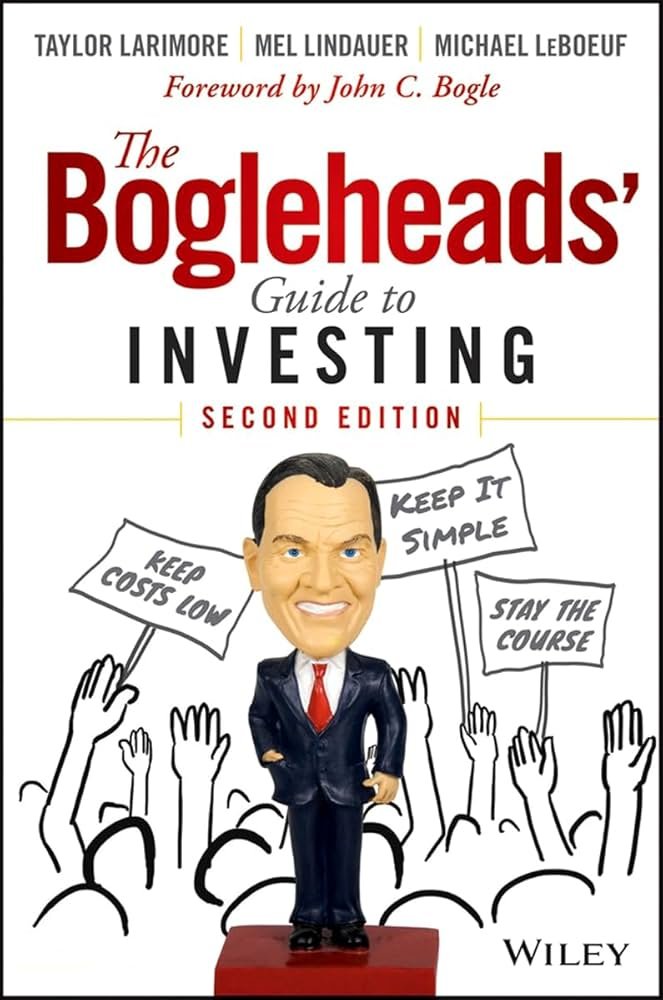
This is the quintessential Boglehead portfolio, championed by Taylor Larimore, co-author of The Bogleheads’ Guide to the Three-Fund Portfolio. It is elegant, diversified, and incredibly low-cost.
- Vanguard Total Stock Market Index Fund (VTSAX/VTI): Represents the entire U.S. stock market.
- Vanguard Total International Stock Index Fund (VTIAX/VXUS): Represents the entire non-U.S. stock market.
- Vanguard Total Bond Market Index Fund (VBTLX/BND): Represents the entire U.S. investment-grade bond market.
How to Allocate:
Your exact allocation depends on your age, risk tolerance, and time horizon.
- Example for a Young Accumulator (Age 25-40):
- 70% VTSAX (U.S. Stocks)
- 20% VTIAX (International Stocks)
- 10% VBTLX (Bonds)
- Rationale: High growth focus, with time to recover from market downturns.
- Example for a Mid-Career Investor (Age 40-55):
- 50% VTSAX
- 20% VTIAX
- 30% VBTLX
- Rationale: Beginning to de-risk the portfolio while still seeking growth.
- Example for a Pre-Retiree/Retiree (Age 55+):
- 40% VTSAX
- 20% VTIAX
- 40% VBTLX
- Rationale: Capital preservation and income generation become more important.
International Allocation Note: A common rule of thumb is to hold 20-40% of your stock allocation in international funds. The 20% in the examples above is on the conservative end; 30% or 40% is also perfectly justifiable based on global market capitalization.
The Two-Fund and One-Fund Portfolios
- Two-Fund Portfolio: For the ultimate purist, some argue that the U.S. Total Stock Market is so globally integrated that international exposure is unnecessary. A two-fund portfolio of just VTSAX and VBTLX is a perfectly valid, simplified approach.
- One-Fund Portfolio: Vanguard offers Target Retirement Funds and LifeStrategy Funds. These are single “fund-of-funds” that contain a pre-mixed allocation of the total market funds. They automatically rebalance and become more conservative over time. For an investor who wants a truly “set-it-and-forget-it” solution, these are an excellent choice, albeit with a slightly higher (but still very low) expense ratio.
Part 4: Implementation: Your Step-by-Step Action Plan
- Get Your Financial House in Order: Pay down high-interest debt (e.g., credit cards). Build an emergency fund with 3-6 months of expenses in a high-yield savings account.
- Determine Your Asset Allocation: Be honest about your risk tolerance. If a 30% market drop would cause you to sell in a panic, your stock allocation is too high.
- Choose Your Accounts:
- Tax-Advantaged Accounts First: Always maximize contributions to these first.
- 401(k)/403(b): Especially if there is an employer match. This is free money.
- IRA (Roth or Traditional): Offers excellent flexibility and tax benefits.
- Taxable Brokerage Account: For investing money beyond the limits of your tax-advantaged accounts.
- Tax-Advantaged Accounts First: Always maximize contributions to these first.
- Select Your Funds: In a 401(k), your choices may be limited. Choose the lowest-cost broad market index funds available. In an IRA or taxable account, you can use the exact Vanguard funds mentioned (or their nearly identical equivalents from other low-cost providers like Fidelity or Charles Schwab).
- Automate Your Investments: Set up automatic contributions from your paycheck or bank account. This enforces dollar-cost averaging and removes emotion from the process.
- Rebalance Periodically (But Not Too Often): Once a year, or when your allocation drifts by more than 5% from your target, sell a bit of what has done well and buy more of what has lagged. This forces you to “buy low and sell high” systematically. Many 401(k)s offer automatic rebalancing.
Read more: The Great Commercial Real Estate Reckoning: Assessing the Risks to US Regional Banks
Part 5: The Unassailable Math: Why This Works
The Boglehead strategy wins because of two powerful financial forces: compounding and the relentless tyranny of compounding costs.
The Cost Argument:
Consider two investors, each with a $100,000 portfolio earning a 7% average annual return before costs over 50 years.
- Investor A (Boglehead): Uses a low-cost index fund with an expense ratio of 0.05%.
- Investor B (Active Investor): Uses an actively managed fund with an expense ratio of 1.00%.
After 50 years:
- Investor A’s Portfolio: ~ $2.87 million
- Investor B’s Portfolio: ~ $2.07 million
The difference of 0.95% in fees cost Investor B $800,000. That money went to Wall Street, not to the investor. This is not a minor detail; it is the central conflict of interest in the investment world.
The Performance Argument:
The SPIVA® (S&P Indices Versus Active) Scorecard consistently shows that over 85% of actively managed large-cap U.S. funds underperform the S&P 500 over a 15-year period. While a few active managers may beat the index in any given year, identifying them in advance and having them continue to outperform is a loser’s game. The index fund guarantees you will never be in the bottom half of performers; it guarantees you will always be in the (high) middle, which, after costs, puts you in the top tier of performers over the long run.
Conclusion: Embrace the Simplicity
The Boglehead Way is not exciting. You will not be able to brag about your brilliant purchase of a hot tech stock at its bottom. You will simply become wealthy, quietly and consistently. It is a philosophy of empowerment, giving you control over your financial future by focusing on the few things you can control: your savings rate, your costs, your diversification, and your behavior.
In a world of financial complexity and noise, the Boglehead philosophy offers the profound gift of simplicity and peace of mind. It is the rational, evidence-based path to financial security for the American investor. As Jack Bogle himself famously said, “Don’t look for the needle in the haystack. Just buy the haystack!”
Read more: The Private Credit Boom: How Shadow Banking is Reshaping US Corporate Finance
Frequently Asked Questions (FAQ)
Q1: I’m convinced, but I don’t have a lot of money to start. Can I still be a Boglehead?
A: Absolutely. In fact, this strategy is ideal for those starting with small amounts. Many brokerages like Vanguard, Fidelity, and Schwab have $0 minimums to open an account for their ETF versions (like VTI, VXUS, BND). You can start with just a few hundred dollars and add to it regularly. The most important step is to start.
Q2: Aren’t there times when it’s smart to be in cash or move to the sidelines during a recession?
A: This is the siren song of market timing, and it is incredibly difficult to do successfully. You have to be right twice: when to get out and when to get back in. Missing just a handful of the market’s best days can devastate your long-term returns. A Boglehead stays fully invested according to their asset allocation. During a downturn, you continue to buy shares at lower prices (dollar-cost averaging), which enhances your long-term returns. Time in the market is more important than timing the market.
Q3: Why should I hold international stocks? The U.S. market has done better for years.
A: While the U.S. has had a strong run, history shows that leadership between U.S. and international markets is cyclical. There have been decades where international stocks significantly outperformed U.S. stocks. Holding international stocks provides diversification, as different economies and markets don’t always move in sync. It’s a form of insurance against a prolonged U.S. downturn. Owning the entire global market is the purest form of diversification.
Q4: What about other asset classes like Real Estate (REITs) or Gold?
A: The Three-Fund Portfolio is complete in itself. However, some Bogleheads choose to add a small “tilting” allocation (e.g., 5-10%) to other asset classes like REITs if they feel it will improve diversification. It’s generally not recommended for beginners. The core principle is to avoid complexity for complexity’s sake. The Three-Fund Portfolio already includes REITs, as they are part of the total stock market.
Q5: How do taxes work with this strategy in a taxable brokerage account?
A: Index funds are remarkably tax-efficient. Because they are passive, they have very low portfolio turnover (they don’t buy and sell stocks often). This means they generate fewer capital gains distributions than actively managed funds. For a taxable account, it’s optimal to use the ETF share classes (VTI, VXUS, BND) which are even more tax-efficient due to their structure.
Q6: I have a 401(k) with poor, high-cost fund options. What should I do?
A: First, contribute at least enough to get the full employer match—it’s an instant 100% return. Then, if the fund options are truly terrible (e.g., all have expense ratios above 1%), you can:
- Maximize your IRA with the ideal low-cost funds.
- If you still have more to invest, go back to the 401(k) and choose the least bad option, usually the one with the lowest expense ratio that tracks a broad index like the S&P 500.
- Advocate for better fund options with your plan administrator.
Q7: Is this strategy only for Vanguard customers?
A: Not at all. While Vanguard pioneered it, other brokerages like Fidelity and Schwab offer virtually identical, ultra-low-cost total market index funds and ETFs (e.g., Fidelity’s FZROX, FZILX or Schwab’s SWTSX, SWISX). The philosophy is what matters, not the specific brand.
Q8: When should I change my asset allocation?
A: The primary reason to change your allocation is a change in your personal circumstances or risk tolerance—not a prediction about the market. As you get within 5-10 years of a major financial goal (like retirement), you should gradually shift to a more conservative allocation. This is often called a “glide path.” Alternatively, if you find you are losing sleep during normal market volatility, your allocation is too aggressive and should be adjusted to a level you can stick with.