In the rapidly evolving landscape of data-driven decision-making, a critical question consistently emerges for aspiring and seasoned data professionals alike: Should I learn Python or R for data analysis? This isn’t just an academic debate; it’s a strategic career decision. The choice between these two powerful languages can influence the types of job opportunities you attract, the projects you work on, and the trajectory of your professional growth.
The answer, as with many things in the tech world, is not a simple “one is better than the other.” Instead, it’s a nuanced understanding of the ecosystem, the specific demands of the US job market, and the long-term goals of the individual. As someone who has built teams of data analysts and scientists, I’ve witnessed firsthand how the strengths of each language play out in real-world business scenarios.
This article will dissect the Python vs. R debate from a practical, US-job-market perspective. We will move beyond theoretical comparisons and delve into hard data, industry trends, and the specific contexts where each language shines. By the end of this guide, you will have a clear, actionable framework to determine which skill—or which combination—holds more value for your career.
Part 1: Understanding the Contenders
Before we dive into market trends, it’s crucial to establish a foundational understanding of what Python and R are, their core philosophies, and their primary ecosystems.
What is Python?
Python is a high-level, general-purpose programming language. Created by Guido van Rossum in 1991, its design philosophy emphasizes code readability and a syntax that allows programmers to express concepts in fewer lines of code than in languages like C++ or Java.
Key Characteristics for Data Analysis:
- Versatility: Python’s greatest strength. It is used for web development (Django, Flask), software development, automation, scripting, and—crucially—data analysis and machine learning. This makes it a “one language to rule them all” for many organizations.
- Syntax: Often described as intuitive and easy to learn, resembling pseudo-code. This lowers the barrier to entry for professionals from non-software engineering backgrounds.
- Core Data Stack: The powerhouse of Python for data is built on a few key libraries:
pandas: For data manipulation and analysis.NumPy: For numerical computations.Scikit-learn: The workhorse for traditional machine learning.Matplotlib&Seaborn: For data visualization.TensorFlow&PyTorch: For deep learning and advanced AI.
Philosophy: Python’s approach to data analysis is that of a programmer. It integrates data tasks seamlessly into larger software systems and production environments.
What is R?
R is a programming language and environment specifically designed for statistical computing and graphics. It was created by Ross Ihaka and Robert Gentleman in the early 1990s and is heavily influenced by the S language.
Key Characteristics for Data Analysis:
- Domain-Specific: R was built by statisticians, for statisticians. Its entire ecosystem is optimized for data analysis, statistical testing, and visualization.
- Syntax: Its syntax is highly expressive for statistical operations. What might take several lines in Python can often be accomplished in a single, elegant line of R code.
- Core Data Stack: R’s power lies in its vast repository of packages, primarily hosted on CRAN (The Comprehensive R Archive Network).
tidyverse(includingdplyr,ggplot2,tidyr): A coherent collection of packages for data manipulation and visualization that has become the modern standard for R.shiny: For building interactive web applications directly from R.caret&tidymodels: For machine learning modeling.- Thousands of specialized packages for niche statistical techniques.
Philosophy: R’s approach is that of a statistician or researcher. It excels at exploratory data analysis, hypothesis testing, and creating publication-quality graphics.
Part 2: The US Job Market Analysis: A Data-Driven Deep Dive
To determine which skill is more “valuable,” we must turn to the market itself. Let’s analyze job postings, salary trends, and industry demand.
Methodology for Market Analysis
This analysis synthesizes data from various sources, including LinkedIn Jobs, Indeed, Glassdoor, and industry reports from platforms like KDnuggets and Stack Overflow. The data reflects trends observed over the past 2-3 years, providing a robust picture of the current landscape.
1. Pure Demand: Job Listings Volume
When searching for data-centric roles in the US, Python consistently appears in significantly more job postings than R.
- Data Scientist Roles: A search for “Data Scientist” jobs on LinkedIn in major tech hubs like San Francisco, New York, or Austin will show that Python is listed as a requirement in 85-90% of postings. R typically appears in 25-35% of postings, often alongside Python.
- Data Analyst Roles: The gap narrows slightly for traditional Data Analyst roles, but Python still maintains a strong lead. In tech-forward companies, Python is often the preferred tool for analysts due to its scalability and integration capabilities.
- The “Either/Or” Phenomenon: Many job postings, especially for analyst roles, will state “Python or R,” indicating that the fundamental skill is analytical thinking, and the tool is secondary. However, when a single tool is specified, it is overwhelmingly Python.
Verdict: Python has a clear and substantial advantage in terms of raw demand across most data-related job titles in the US.
2. Industry-Specific Demand
While Python leads in aggregate, the picture changes when we look at specific industries where R’s statistical heritage is a core asset.
Industries Favoring Python:
- Technology & SaaS: The epicenter of Python adoption. Its use in production systems, A/B testing frameworks, and machine learning pipelines is ubiquitous.
- Finance (Quantitative & FinTech): Python is dominant for algorithmic trading, risk modeling, and building financial platforms.
- E-commerce & Retail: Used for recommendation systems, inventory forecasting, and customer analytics at scale.
- Startups: Valued for its versatility, allowing a small team to use one language for data analysis, backend services, and automation.
Industries Where R Holds Strong:
- Pharmaceuticals & Biostatistics: R is the historical and often mandatory standard for clinical trial analysis, drug discovery, and genomic research. Regulatory environments are familiar with R outputs.
- Academic Research & Social Sciences: R remains the go-to tool in many university departments for its cutting-edge statistical packages and superior data visualization capabilities (
ggplot2). - Market Research & Public Policy: Used for survey analysis, public opinion polling, and economic modeling.
Verdict: Your target industry matters. For tech, finance, and general-purpose business analytics, Python is the safe bet. For highly specialized statistical roles in academia, life sciences, and research, R can be not just valuable, but essential.
3. Salary Comparison
Is there a salary premium for one language over the other? The data suggests a nuanced answer.
- Average Salaries: On average, roles that require Python (e.g., Data Scientist, Machine Learning Engineer) tend to have higher reported salaries than those listing R (e.g., Statistician, Biostatistician). However, this is largely a reflection of the roles themselves rather than the language. Machine Learning Engineers, who almost exclusively use Python, command top-tier salaries.
- The Specialization Premium: Highly specialized R roles, such as Senior Biostatistician in a top pharmaceutical company, can offer salaries that are extremely competitive and often exceed those of generalist data analysts.
- The Combination Bonus: The highest earning potential often lies with professionals who are bilingual—proficient in both. This demonstrates a deep understanding of the entire data value chain, from statistical rigor (R’s strength) to production deployment (Python’s strength).
Verdict: Python is associated with higher-paying job titles on average, but mastery of R in its niche domains can be equally lucrative. The ultimate salary booster is proficiency in both.
Read more: AI Beyond the Hype: Identifying Secondary and Tertiary Winners in the US Market
4. Long-Term Trends and Trajectory
A valuable skill is not just about today’s demand, but tomorrow’s.
- Python’s Momentum: Python’s growth has been explosive, driven by its dominance in the AI and machine learning revolution. Frameworks like TensorFlow and PyTorch have cemented its position as the language of the future for advanced analytics. Its general-purpose nature makes it a safer long-term investment as job roles evolve.
- R’s Steady State: R is not declining; it is maturing. Its growth is more measured and concentrated within its core domains. The
tidyversehas modernized the language and ensured its continued relevance for statistical computing. It is unlikely to disappear from its strongholds anytime soon.
Verdict: Python has stronger momentum and is better positioned for the future of AI and large-scale data processing. R’s future is secure but will likely remain more niche.
Part 3: A Practical Side-by-Side Comparison
Let’s break down the key technical and practical differences.
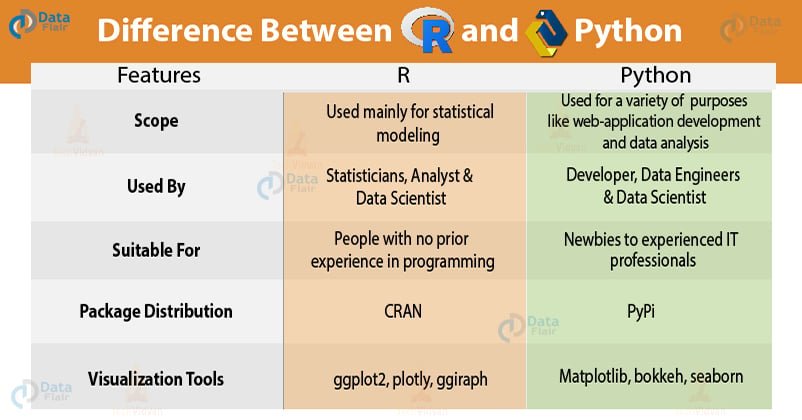
| Feature | Python | R |
|---|---|---|
| Primary Strength | General-purpose programming, ML/AI, production systems | Statistical analysis, data exploration, academic research |
| Learning Curve | Gentle initial curve, especially for those with programming experience. | Steeper initial curve for non-programmers, but intuitive for statistical tasks. |
| Data Handling | Excellent with pandas, but can be memory-intensive with huge datasets. | Designed for in-memory data analysis. Excellent with data frames natively. |
| Data Visualization | Functional and customizable with Matplotlib/Seaborn. More code required for complex graphs. | Best-in-class with ggplot2 (based on Grammar of Graphics). More elegant for statistical plots. |
| Statistical Modeling | Strong with Scikit-learn, Statsmodels. Broad coverage of ML algorithms. | Deeper and more granular statistical capabilities. Vast array of niche statistical packages. |
| Performance & Speed | Generally faster for general computation and large-scale data processing. | Can be slower for some tasks, but performance is improved with libraries like data.table. |
| Community & Ecosystem | Massive, diverse community (web dev, automation, data). Solutions for every problem. | Focused, academic, and statistical community. Unmatched for specialized stats. |
| Integration & Deployment | Excellent. Integrates with databases, APIs, and web frameworks. Ideal for deploying models as APIs. | Good, but more complex. shiny allows for web apps, but deployment is not as seamless as Python. |
Part 4: The Verdict: Which Skill Should You Learn?
Based on the market analysis and technical comparison, here is a strategic guide for different career paths.
Learn Python if:
- You are new to programming and data analysis and want the skill with the widest applicability.
- Your goal is to become a Data Scientist, Machine Learning Engineer, or AI Specialist.
- You want to work in the tech industry, a startup, or in a role that involves building and deploying data products.
- You value the ability to automate tasks, build web applications, or work outside the strict confines of data analysis.
- You are aiming for a role with the highest possible number of job openings.
Python is the undisputed king for end-to-end data science, from scraping data to putting a machine learning model into production.
Learn R if:
- Your primary interest is in pure statistical analysis, research, and data exploration.
- You plan to work in academia, pharmaceuticals, biostatistics, or market research.
- Your work heavily involves creating complex and publication-ready data visualizations.
- You are working in a environment where R is the established, industry-standard tool (common in certain government and research roles).
- You are a statistician or domain expert (e.g., biologist, economist) who needs immediate access to the latest statistical methodologies.
R remains the specialist’s tool of choice for deep, nuanced statistical work and research.
The “Win-Win” Strategy: Become Bilingual
The most valuable and resilient data professionals are often proficient in both. You don’t need to learn them simultaneously, but having both in your toolkit is a powerful differentiator.
- Start with One: Choose your first language based on the guidelines above.
- Achieve Proficiency: Become genuinely proficient in your first language. Build projects, solve problems.
- Strategically Learn the Second: Once you are comfortable, invest time in learning the other. You will find that understanding one makes learning the other easier, as the core data concepts are the same.
- Leverage the Right Tool for the Job: Use R for rapid prototyping of statistical models and creating beautiful visualizations for a report. Use Python to take that validated model and build a scalable API around it. This bilingual approach is the hallmark of a senior, strategic data professional.
Conclusion
In the head-to-head battle for value in the US job market, Python emerges as the more generally valuable skill. Its versatility, dominance in high-growth fields like AI, and overwhelming presence in job postings make it the default starting point for most aspiring data professionals.
However, declaring a universal winner would be a disservice to the power of R. R is not a “lesser” language; it is a more specialized one. In its domains of strength, it is not just competitive—it is superior. Its value is immense and specific.
Therefore, the final recommendation is this:
- For maximum breadth, future-proofing, and job opportunities, learn Python.
- For deep statistical work in specific research-driven industries, learn R.
- For ultimate career capital and flexibility, strive to eventually learn both.
Your career is a journey, not a single choice. Start with the language that aligns with your immediate goals, but keep an eye on the horizon. In the world of data, the most valuable skill is the ability to learn and adapt. Whether you choose Python, R, or both, you are investing in a skill set that will remain at the forefront of the 21st-century economy.
Read more: Demographics as Destiny: An Equity Analysis of US Healthcare and Senior Living
Frequently Asked Questions (FAQ)
Q1: I’m a complete beginner. Which language is easier to learn?
For someone with no programming background, both have challenges. However, Python often has a gentler initial learning curve due to its intuitive, readable syntax that resembles English. It feels more like general-purpose programming. R’s syntax can be unintuitive at first, especially with its focus on vector operations. However, for individuals with a strong statistics background, R’s concepts may feel more natural.
Q2: Can I do everything in Python that I can do in R, and vice versa?
Theoretically, yes. Practically, no. Each has its strengths. You can perform complex statistical tests in Python using SciPy and Statsmodels, but R often has more specialized, cutting-edge packages directly from academia. You can build web apps and production models in R with shiny and tidymodels, but Python’s ecosystem for deployment (e.g., Flask, FastAPI) is more robust and integrated. It’s about using the right tool for the job efficiently.
Q3: Are there jobs that specifically require both Python and R?
While less common, some job postings, especially for senior or research scientist roles, will list both as “nice-to-have” or even required. This indicates the employer is looking for a flexible, tool-agnostic expert who can leverage the best of both worlds. Being proficient in both significantly widens your opportunities and makes you a more compelling candidate.
Q4: Is SQL more important than both Python and R?
For data analysis roles, SQL is arguably the most fundamental skill. It is the primary language for querying databases to extract and manipulate data. You will almost always use SQL to get your data before you analyze it in Python or R. A strong data professional is typically proficient in SQL and at least one of Python or R.
Q5: How does the salary compare for Python vs. R roles?
As discussed, this is role-dependent. On average, Python-centric roles like Machine Learning Engineer command higher salaries. However, a Principal Biostatistician using R in the pharmaceutical industry can have a comparable, if not higher, salary. The tool is a factor, but your domain expertise, experience, and job function are the primary drivers of your salary.
Q6: Which language has a better future with the rise of AI?
Python is the unequivocal leader in AI and machine learning. All major deep learning frameworks (TensorFlow, PyTorch) are Python-first. The vast majority of research and development in AI is conducted using Python. While R has packages for machine learning (e.g., tidymodels, torch for R), it is not a major player in this specific, high-growth field.
Q7: How long does it take to become proficient enough to get a job?
This varies widely based on your background, learning pace, and the intensity of your study. With a dedicated, structured learning plan (e.g., 15-20 hours per week), one could reach a job-ready proficiency in the fundamentals of either language (including key libraries like pandas or tidyverse) in 6 to 12 months. Building a strong portfolio of projects is key to demonstrating this proficiency.
Q8: Should I learn Python or R for data visualization?
R, specifically with the ggplot2 package, is generally considered superior for creating static, publication-quality statistical graphics. Its “Grammar of Graphics” philosophy provides a consistent and powerful system for building complex plots. Python’s Matplotlib is highly customizable but can be more verbose, while Seaborn provides a higher-level, more statistical interface. For interactive visualizations, both have strong options (Plotly for both, Bokeh for Python).