For nearly eight decades, the US dollar has reigned supreme. It is the world’s primary reserve currency, the dominant medium for international trade, the preferred unit for financial transactions, and the default safe-haven asset in times of crisis. This “exorbitant privilege,” as French Finance Minister Valéry Giscard d’Estaing once called it, has afforded the United States unparalleled economic and geopolitical advantages, from the ability to run large deficits with relative impunity to wielding financial power as a tool of foreign policy.
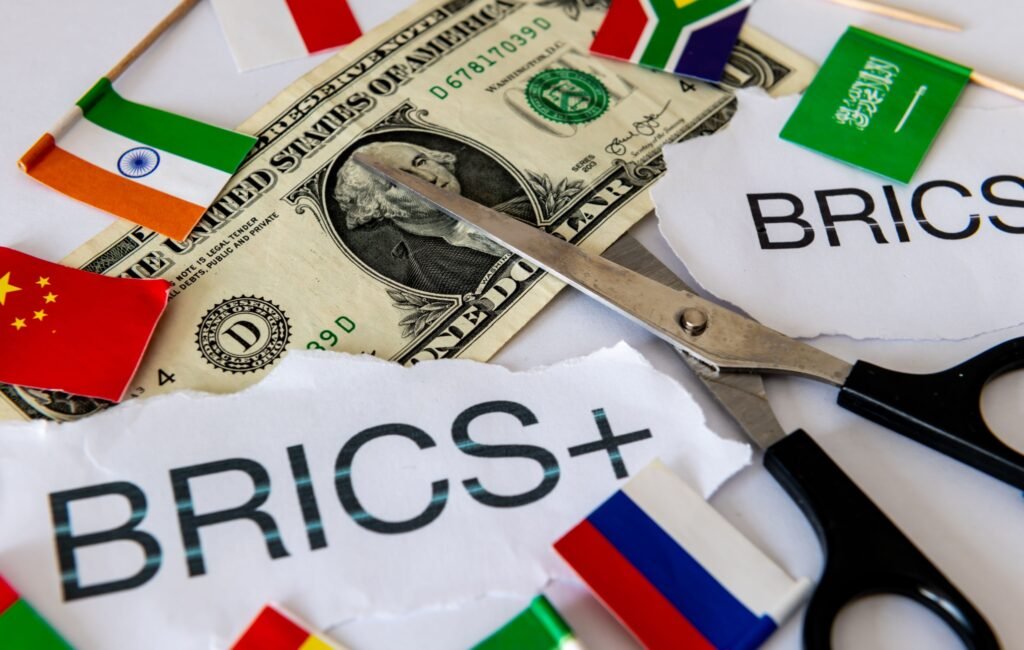
However, a chorus of voices is growing louder, proclaiming that the dollar’s hegemony is facing an unprecedented challenge. Headlines scream of “de-dollarization,” a process where nations seek to reduce their dependence on the US dollar. The BRICS bloc (Brazil, Russia, India, China, South Africa) is expanding and openly discussing a rival currency. China is aggressively promoting the international use of the renminbi (RMB). Sanctions against Russia have triggered a frantic search for non-dollar payment systems. From politicians to pundits, a narrative is taking hold: the dollar’s days at the top are numbered.
But is this narrative accurate? Is the US dollar’s reserve currency status truly under a credible, imminent threat, or are we witnessing a gradual, manageable rebalancing of the global monetary system? This article delves deep into the de-dollarization debate, separating geopolitical hype from financial reality. We will examine the powerful forces propping up the dollar’s dominance, the genuine cracks beginning to show, and the most probable future for the world’s primary reserve currency. The story is not one of abrupt collapse, but of a slow-burning evolution whose outcome is far from certain.
Part 1: The Unrivaled Pillars of Dollar Dominance
To understand whether the dollar can be dethroned, one must first appreciate the profound and deeply entrenched foundations of its power. Its status is not an accident of history but is built upon a series of interlocking pillars that create a network effect of immense strength.
1. The Trust and Stability of the US Economy
At its core, a reserve currency must be a stable store of value. The US, despite its political divisions and fiscal challenges, remains the world’s largest and most technologically advanced economy. Its deep and liquid capital markets are unparalleled. The US Treasury market, with over $25 trillion in outstanding debt, is the deepest and most liquid debt market on earth. This provides global investors, central banks, and institutions with a safe, reliable, and easily tradable asset to park their reserves.
Furthermore, the US has a long history of respecting the rule of law and property rights. Investors trust that their dollar-denominated assets will not be arbitrarily confiscated by the government. This trust is the bedrock of the dollar’s global role. While the US has used its financial power to impose sanctions, these are generally viewed as targeted measures against specific entities or nations, not a wholesale repudiation of financial obligations to the world.
2. The Network Effect: A Self-Reinforcing Cycle
The dollar benefits from what economists call a “network effect”—its value increases the more people use it. This creates a powerful, self-reinforcing cycle:
- Trade Invoicing: A vast portion of global trade, including commodities like oil, gas, and metals, is priced and invoiced in US dollars. An Indian company buying oil from Saudi Arabia will likely transact in dollars, not rupees or riyals. This creates an automatic, constant global demand for dollars to facilitate commerce.
- Financial Transactions: The global financial system is dollar-centric. International loans, bonds, and derivatives are predominantly denominated in dollars. Banks around the world need dollar funding to operate, making the global interbank system reliant on the Federal Reserve’s liquidity operations.
- Central Bank Reserves: As of Q4 2023, the US dollar constitutes nearly 59% of allocated global foreign exchange reserves. While down from over 70% at the turn of the millennium, this is still a dominant share. When central banks hold dollars, they inherently reinforce the currency’s stability and demand.
This network effect creates immense inertia. Shifting away from the dollar requires a coordinated, global effort to build an entirely new financial ecosystem—a monumental task.
3. The Lack of a Credible Challenger
This is perhaps the most critical point in the dollar’s favor. For a currency to replace the dollar, it must offer the same or better combination of size, stability, liquidity, and trust.
- The Euro (EUR): The euro is the world’s second-most important reserve currency, with about 20% of global reserves. However, it is hampered by the fragmented nature of the Eurozone’s sovereign debt markets. There is no single “European bond” with the depth and liquidity of US Treasuries. Furthermore, the eurozone lacks a unified fiscal policy and a central treasury, creating structural vulnerabilities exposed during the 2010-2012 sovereign debt crisis.
- The Japanese Yen (JPY) and British Pound (GBP): Both are major currencies, but their economies are simply too small relative to the US to support a global reserve currency. Japan’s economy is plagued by decades of deflation and stagnant growth, while the UK’s was diminished by Brexit.
- The Chinese Renminbi (RMB): China is the most frequently cited potential challenger. It has the world’s second-largest economy and is actively promoting the RMB’s international use. However, the RMB faces fundamental, and likely insurmountable, obstacles in the short to medium term. The Chinese government maintains strict capital controls, preventing the free flow of money in and out of the country. Its financial markets are not fully developed or transparent. Most critically, China lacks the rule of law and institutional trust that underpins the dollar. The Chinese Communist Party’s ability to intervene arbitrarily in the economy and legal system deters foreign central banks from placing a significant portion of their national wealth in RMB assets. The RMB’s share of global reserves remains stuck at around 2.5%, a clear indicator of this lack of trust.
In essence, the world may be growing weary of dollar dominance, but it has nowhere else to go—at least not yet.
Part 2: The Gathering Storm: Genuine Threats to Dollar Hegemony
While the dollar’s position is robust, it is not impervious. The geopolitical and economic landscape is shifting, and a combination of deliberate actions and unintended consequences is creating tangible headwinds.
1. The Weaponization of the Dollar and the “Sanctions Overhang”
The US’s use of financial sanctions as a primary tool of foreign policy, particularly since 9/11 and more aggressively in recent years, has been a catalyst for de-dollarization efforts. The freezing of approximately $300 billion of Russia’s central bank reserves following its invasion of Ukraine was a watershed moment. For many countries, especially those not aligned with US foreign policy, it served as a stark warning: your assets are not safe in the Western financial system if you fall out of favor.
This has created a powerful incentive for nations to seek alternatives. It is no coincidence that the most vocal proponents of de-dollarization—Russia, China, Iran—are also the most heavily sanctioned. They are actively building parallel financial infrastructures, such as China’s Cross-Border Interbank Payment System (CIPS) as an alternative to SWIFT, and promoting bilateral trade in local currencies. While these systems are currently small and inefficient compared to the dollar-based system, they represent a strategic hedge against US financial power. The “sanctions overhang” has introduced a geopolitical risk premium to holding dollars that did not exist two decades ago.
2. The Rise of Economic Blocs and Regional Alternatives
The expansion and increasing assertiveness of the BRICS bloc is a clear manifestation of the desire for a multipolar world. While talk of a common BRICS currency is fanciful (due to vast economic and political differences among members), the group is actively promoting trade in local currencies. This “de-dollarization by a thousand cuts” may not replace the dollar overnight, but it can gradually erode its share in global trade invoicing.
Similarly, regional initiatives are gaining traction. India and Malaysia have agreed to settle trade in Indian rupees. China has signed local currency swap agreements with dozens of countries. Saudi Arabia is now openly considering pricing some of its oil sales to China in RMB. While symbolic at first, these actions chip away at the dollar’s monopoly in the critical energy market.
3. Macroeconomic Erosion: Debt and Deficits
The long-term strength of a currency is tied to the fiscal and monetary discipline of its issuer. Here, the US faces significant challenges. The US national debt has surpassed $34 trillion, and persistent large budget deficits are the norm. While the US has the unique ability to finance its debt in its own currency, there is a theoretical limit to this privilege. If investors and central banks ever begin to doubt the US government’s commitment to fiscal sustainability, it could trigger a loss of confidence, leading to higher inflation and a weaker dollar.
The Federal Reserve’s aggressive monetary policy responses to crises, while necessary domestically, can also have destabilizing global effects, creating “dollar shortages” that strain emerging markets. This “dollar doom loop”—where the Fed’s actions to protect the US economy cause collateral damage abroad—fuels resentment and the desire for independence.
Part 3: The Reality Check: Distinguishing Hype from Reality
Amidst the alarming headlines, it is crucial to apply a cold, analytical lens to the data and on-the-ground realities.
The “Rise” of the RMB is Mostly a Regional Phenomenon
China’s success in internationalizing the RMB has been largely confined to its immediate sphere of influence and with countries dependent on its trade. The RMB’s use in global payments, as tracked by SWIFT, remains around 2-3%, barely changed in a decade. Most “RMB trade” is with China itself; it is not being widely used as a third-party trade currency between, say, Brazil and South Africa. The capital controls remain a non-negotiable feature for the CCP, which prioritizes financial stability and control over the RMB’s international status.
Local Currency Trade is Incremental, Not Transformative
Agreements to trade in local currencies are positive steps for bilateral relations, but they are logistically complex and often less efficient. They require developed foreign exchange markets for both currencies, which many emerging economies lack. Without a central, liquid vehicle currency like the dollar, the transaction costs can be higher. These arrangements are more about reducing dollar dependency in specific corridors than replacing the dollar as the global benchmark.
The Dollar’s “Decline” is a Slow Rebalancing, Not a Freefall
The dollar’s share of global reserves has indeed declined from its peak of over 70% to about 59%. However, this decline has been remarkably slow and gradual over 20 years. Much of this shift is not due to a mass exodus from the dollar, but rather a prudent diversification by central banks into other minor currencies like the Australian dollar, Canadian dollar, and South Korean won—all of which are close allies of the US. It reflects a more multipolar allocation of reserves, not an anti-dollar revolt.
The “Exorbitant Privilege” is Also an “Exorbitant Burden”
While the US benefits from the dollar’s status, it also bears costs. A strong dollar makes US exports less competitive, hollowing out manufacturing. The influx of foreign capital seeking safe US assets can fuel asset bubbles. This dynamic creates a complex set of domestic winners and losers, suggesting that a gradual, managed decline in dollar dominance might not be an entirely negative outcome for the US in the long run.
Read more: Data-Driven Decision Making: How American Companies Are Gaining a Competitive Edge
Part 4: The Most Probable Future: A “Multi-Currency” World, Not a “Post-Dollar” One
Based on the evidence, the most likely trajectory for the global monetary system is not the replacement of the dollar by a single new hegemon, but the emergence of a fragmented, multi-currency system.
In this future scenario:
- The Dollar Remains Primus Inter Pares: The US dollar will likely remain the world’s primary reserve currency for the foreseeable future, but its dominance will be less absolute. Its share of global reserves may settle into a range of 40-50%, still the largest single share.
- Regional Currency Blocs Emerge: The euro will solidify its role as the regional reserve currency for Europe and parts of Africa. The renminbi will become the dominant currency for trade and finance within China’s Asian sphere of influence. Other regional powers may see their currencies used more for local trade.
- Digital Assets and CBDCs Play a Niche Role: Central Bank Digital Currencies (CBDCs), particularly a digital dollar, could streamline cross-border payments and reinforce the status of major currencies. Cryptocurrencies and stablecoins may find roles in niche areas but are unlikely to challenge sovereign currencies for reserve status due to volatility and regulatory hurdles.
- The System Becomes More Complex and Less Efficient: A multi-currency world is a more complex one for global trade and finance. Businesses and banks will face higher hedging costs and operational friction. The stabilizing function of a single, deep safe asset (US Treasuries) will be diminished, potentially making the global financial system more prone to volatility during crises.
Conclusion: An Era of Managed Decline, Not Catastrophic Collapse
The de-dollarization debate is often framed in binary terms: will the dollar fail or won’t it? This is a false dichotomy. The evidence points not to an imminent collapse of the dollar’s reserve status, but to the beginning of a long, slow, and managed decline in its exclusive dominance.
The pillars of the dollar’s power—the deep US markets, the rule of law, and the immense network effects—remain formidable. There is no credible challenger on the horizon capable of replicating this entire ecosystem. However, the geopolitical backlash to the weaponization of the dollar, combined with the natural desire for a more multipolar world, is unleashing forces that cannot be ignored.
The world is not hurtling towards a “post-dollar” era. Instead, it is gradually, and often awkwardly, feeling its way toward a “less-dollar” one. The US dollar will remain the single most important global currency for decades to come, but it will no longer enjoy the near-monopoly it has held since Bretton Woods. For policymakers, investors, and businesses, the imperative is to prepare for a more complex, fragmented, and multi-currency international financial landscape, where strategic hedging and diversification are not just options, but necessities.
Read more: The Cashless Continent? Why the US Lags in Digital Payments and What’s Changing
Frequently Asked Questions (FAQ)
Q1: What exactly is de-dollarization?
De-dollarization is the process by which countries, central banks, corporations, and investors reduce their reliance on the US dollar for international trade, finance, and as a store of value. This can involve using other currencies (euros, renminbi, etc.) for trade invoicing, diversifying foreign exchange reserves away from the dollar, and developing alternative financial payment systems to those dominated by the US.
Q2: Is the creation of a BRICS currency a real threat to the dollar?
In the short to medium term, no. Creating a successful common currency requires a level of political, fiscal, and monetary integration that the BRICS nations are far from achieving. The euro required decades of negotiation and the ceding of national sovereignty by its members. The economically and politically diverse BRICS bloc (which includes democracies and autocracies, and economies at vastly different stages of development) shows no signs of this level of integration. For now, talk of a BRICS currency is more of a political statement than a practical monetary proposal.
Q3: How do US sanctions actually drive de-dollarization?
Sanctions drive de-dollarization by demonstrating the risk of relying on the US-led financial system. When the US blocks a country (like Russia or Iran) from using the SWIFT messaging system or freezes its dollar-denominated assets, it signals to other nations that their assets could also be at risk if they conflict with US foreign policy. This incentivizes them to develop alternative payment channels (like China’s CIPS) and to hold a greater portion of their reserves in gold or other non-dollar assets to insulate themselves from potential future sanctions.
Q4: What are the practical benefits for countries that trade in their own local currencies?
The primary benefits are:
- Reduced Exchange Rate Risk: Companies can avoid the cost and risk of converting their local currency into dollars and then back into another local currency for trade.
- Lower Transaction Costs: They can bypass bank fees associated with dollar conversions.
- Enhanced Financial Sovereignty: It reduces their vulnerability to US monetary policy and financial sanctions, giving them greater autonomy.
Q5: Could the US Dollar be replaced by a digital currency, like Bitcoin or a CBDC?
It is highly unlikely that a decentralized cryptocurrency like Bitcoin will replace the dollar as the global reserve currency. Their price volatility, scalability issues, and lack of a sovereign backing make them unsuitable as a stable store of value for national reserves. However, Central Bank Digital Currencies (CBDCs), particularly a digital dollar, could play a significant role in the future. A well-designed digital dollar could potentially make cross-border payments more efficient and even reinforce the dollar’s dominance by integrating new technologies. The key differentiator is that a CBDC is a sovereign currency, just in a new technological form.
Q6: What would a decline in the dollar’s status mean for the average American?
A significant decline would have mixed effects:
- Potential Negatives: The US government and American consumers would likely face higher interest rates, as foreign demand for US debt wanes. This could slow economic growth and increase the cost of mortgages and car loans. The cost of imported goods could rise if the dollar weakens.
- Potential Positives: A weaker dollar could make US exports more competitive, potentially boosting manufacturing and creating jobs in export-oriented industries. It could also reduce the financial imbalances that have contributed to deindustrialization in some US regions.
Q7: Where is the safest place for my money if the dollar weakens?
For individual investors, the principles of diversification are key. Rather than betting against the dollar, a prudent strategy includes holding a diversified portfolio of assets. This can include:
- A mix of global stocks and bonds (denominated in other currencies).
- Investments in tangible assets like real estate or commodities.
- A small, strategic allocation to gold, which has historically acted as a hedge against currency debasement and geopolitical uncertainty.
It is always recommended to consult with a qualified financial advisor for personalized advice.