In the relentless arena of American commerce, a quiet revolution has shifted the very foundations of strategy and execution. Gone are the days when gut feelings, seniority-based opinions, and “this is how we’ve always done it” were sufficient guides for steering an enterprise. In their place, a new currency has emerged: data. The ability to collect, analyze, and act upon data is no longer a niche advantage for tech giants; it is the core differentiator between industry leaders and the left-behind.
Data-Driven Decision Making (DDDM) is the disciplined practice of basing strategic and operational choices on empirical evidence and data analysis rather than purely on intuition. For American companies navigating post-pandemic supply chain shocks, inflationary pressures, and rapidly evolving consumer behaviors, DDDM has become a non-negotiable component of resilience and growth. It’s the compass that allows businesses to navigate uncertainty, optimize performance, and discover hidden opportunities.
This article will serve as a comprehensive guide to how American businesses are leveraging DDDM to secure a formidable competitive edge. We will explore the fundamental pillars of a data-driven organization, present real-world case studies from various industries, outline a practical framework for implementation, and address the common challenges and ethical considerations that define the modern data landscape. By understanding and embracing these principles, your company can transition from simply having data to being driven by it.
Section 1: The Pillars of a Data-Driven Organization in the US
Becoming data-driven is not merely about purchasing the latest analytics software. It is a holistic transformation that rests on four critical pillars: Culture, Technology, Process, and People.
1.1 Cultural Shift: From HiPPO to Data
The single greatest barrier to DDDM is often cultural, not technical. The HiPPO (Highest Paid Person’s Opinion) can stifle innovation and lead to costly missteps.
- Leadership Buy-in and Advocacy: The transformation must start at the top. When C-suite executives consistently demand data to support proposals, celebrate data-informed wins, and use data dashboards in strategic meetings, it sends a powerful message throughout the organization. Leaders must champion a culture of inquiry where “what does the data say?” is a standard reflex.
- Democratization of Data: Data cannot be siloed within the IT or data science departments. Modern business intelligence (BI) tools like Tableau, Power BI, and Looker are designed for ease of use, allowing marketing managers, sales representatives, and operations leads to explore data relevant to their roles. This empowers employees at all levels to find answers and make informed decisions quickly.
- Psychological Safety and Experimentation: A data-driven culture embraces experimentation and is not afraid of failure. When a data-backed hypothesis proves incorrect, it should be treated as a learning opportunity, not a punishable offense. This requires building an environment of psychological safety where teams can test new ideas through A/B testing, pilot programs, and other empirical methods.
1.2 Technological Foundation: The Modern Data Stack
The infrastructure that supports DDDM has evolved into a sophisticated ecosystem known as the “Modern Data Stack.” While specific tools vary, the architecture generally includes:
- Data Sources & Ingestion: This includes all the places where data originates—CRM systems (Salesforce), ERP software (SAP), marketing platforms (Google Analytics, HubSpot), transactional databases, and even IoT sensors. Tools like Fivetran and Stitch automate the extraction and loading of this data into a central repository.
- Cloud Data Warehouse: The heart of the modern stack. Instead of legacy on-premise servers, companies use scalable, cloud-based warehouses like Amazon Redshift, Google BigQuery, or Snowflake. These platforms can store and process massive volumes of structured and semi-structured data at high speed and relatively low cost.
- Transformation & Modeling: Raw data is often messy and unusable. Tools like dbt (data build tool) are used within the warehouse to clean, enrich, and model this data into consistent, reliable tables that business users can easily understand. This step is crucial for creating a “single source of truth.”
- Business Intelligence (BI) & Analytics: This is the presentation layer where the data becomes insight. Platforms like Tableau, Microsoft Power BI, and Looker connect to the transformed data in the warehouse to create interactive dashboards, reports, and visualizations that tell a story.
- Data Science & Advanced Analytics: For more sophisticated use cases like predictive modeling and machine learning, platforms like DataRobot and Databricks, along with languages like Python and R, are used to build forecasts, identify complex patterns, and automate decision-making.
1.3 Process: The Framework for Action
Data without a process for action is just noise. A disciplined, repeatable process turns insights into outcomes.
- Ask the Right Question: Start with a clear, business-oriented question. “How can we reduce customer churn?” is better than a vague “analyze customer data.”
- Collect and Prepare Data: Identify and gather the relevant data from the sources outlined above, ensuring it is clean and reliable.
- Analyze and Explore: Use descriptive analytics (what happened), diagnostic analytics (why it happened), and predictive analytics (what will happen) to uncover patterns and correlations.
- Visualize and Interpret: Create clear visualizations to communicate findings effectively to stakeholders. A well-designed chart can convey more than a 100-page report.
- Make the Decision and Act: The data should inform the decision, not necessarily make it automatically. Context, experience, and ethics must still be applied.
- Monitor and Iterate: Track the results of the decision against key performance indicators (KPIs). Use this feedback to refine the approach and ask new questions.
1.4 People: The Human Element
Technology and process are useless without the right people.
- Data Literacy for All: A baseline understanding of how to read a chart, interpret a KPI, and question data sources should be a core competency for every employee, much like proficiency with email.
- Specialized Roles: While data literacy is broad, specialized roles are essential. This includes Data Engineers (who build and maintain the data infrastructure), Data Analysts (who interpret data and create reports), Data Scientists (who build complex models), and Analytics Translators (who bridge the gap between technical teams and business units).
Section 2: Case Studies in Competitive Advantage
The theoretical benefits of DDDM are compelling, but real-world examples from iconic American companies bring them to life.
Case Study 1: Starbucks – Brewing Success with Location Intelligence
The Challenge: With over 15,000 stores in the US alone, opening a new location is a multi-million dollar decision. A poor choice can lead to years of underperformance.
The Data-Driven Approach: Starbucks uses a sophisticated blend of data for site selection. This includes:
- Demographic Data: Income levels, education, and population density from the US Census Bureau and other sources.
- Traffic Patterns: Vehicle and foot traffic data from geographic information systems (GIS).
- Competitive Landscape: Locations of competitors and complementary businesses.
- Predictive Modeling: They analyze the data to forecast potential sales and profitability for a proposed location, simulating its performance before a single brick is laid.
The Competitive Edge: This rigorous, data-driven method drastically reduces the risk of new store openings and ensures each location has the highest probability of success. It allows Starbucks to saturate markets efficiently without cannibalizing its own sales, a key advantage in a highly competitive retail landscape.
Case Study 2: Amazon – The Personalization Engine
The Challenge: How do you help customers find products they want from a catalog of hundreds of millions in a vast, digital marketplace?
The Data-Driven Approach: Amazon’s entire business is built on data. Their recommendation engine is a masterpiece of DDDM, powered by:
- Collaborative Filtering: “Customers who bought X also bought Y.”
- Item-to-Item Collaborative Filtering: A more scalable technique that matches similar products.
- Natural Language Processing (NLP): Analyzing search queries and product reviews to understand intent and sentiment.
- Real-Time Behavioral Data: Tracking clicks, hover time, and purchase history to update recommendations instantly.
The Competitive Edge: It’s estimated that 35% of Amazon’s revenue is driven by its recommendation engine. By creating a highly personalized and efficient shopping experience, Amazon dramatically increases conversion rates, average order value, and, most importantly, customer loyalty. This creates a powerful network effect that is nearly impossible for competitors to replicate.
Case Study 3: American Express – Forecasting Financial Risk
The Challenge: For a credit card company, accurately predicting charge-offs (debts that are unlikely to be collected) is critical for profitability and risk management.
The Data-Driven Approach: American Express uses machine learning models to analyze over 100 variables for each cardholder, including:
- Transaction History: Spending patterns, merchant categories, and transaction amounts.
- Customer Demographics and Behavior.
- Macro-economic Data. The models can identify subtle, complex patterns that signal a cardholder’s increasing risk of default long before it becomes obvious.
The Competitive Edge: This allows Amex to take proactive measures, such as adjusting credit limits or offering financial counseling, to mitigate losses. This precise risk management enables them to serve a broader range of customers profitably and maintain a stronger financial position than less sophisticated competitors.
Section 3: A Practical Framework for Implementing DDDM
For a US-based company looking to embark on this journey, here is a practical, step-by-step framework.
Phase 1: Assess and Align (Months 1-2)
- Conduct a Data Maturity Audit: Evaluate your current state. Where is your data? How clean is it? Who has access?
- Identify Key Business Objectives: Start with the business problem, not the data. Do you want to increase customer retention? Improve supply chain efficiency? Reduce operational costs? Align your first DDDM projects directly to these top-priority goals.
- Secure an Executive Sponsor: Find a C-level leader who understands the value and will champion the initiative.
Phase 2: Build the Foundation (Months 3-6)
- Start Small, Think Big: Don’t try to boil the ocean. Choose one or two high-impact, manageable projects for your first foray.
- Invest in Core Technology: Select and implement the foundational components of your modern data stack, starting with a cloud data warehouse and a BI tool.
- Establish a “Single Source of Truth”: Use a tool like dbt to create clean, trusted data models for your initial projects. This builds confidence in the data across the organization.
Phase 3: Execute and Democratize (Months 6-12)
- Run Your Pilot Projects: Execute on the use cases identified in Phase 1. Ensure close collaboration between business and technical teams.
- Communicate Wins Widely: When a pilot project leads to a tangible business outcome—e.g., “by using data to optimize our PPC ads, we reduced customer acquisition cost by 15%”—share that success across the company.
- Launch Data Literacy Training: Begin rolling out training programs tailored to different roles (e.g., “Data for Marketers,” “Finance Dashboard Fundamentals”).
Phase 4: Scale and Innovate (Year 2 and Beyond)
- Expand the Scope: Apply the DDDM methodology to more business units and more complex problems.
- Explore Advanced Analytics: Once descriptive analytics are embedded, begin experimenting with predictive and prescriptive analytics.
- Foster a Community of Practice: Create forums where data-minded employees can share best practices and success stories, further cementing the cultural shift.
Read more: The US Infrastructure Boom: An Equity Playplay for the Next Decade
Section 4: Navigating Challenges and Ethical Considerations
The path to becoming data-driven is not without its obstacles. Proactively addressing these is key to sustainable success.
- Data Quality and Silos: The old adage “garbage in, garbage out” holds true. Inconsistent, duplicate, or inaccurate data lurking in departmental silos is the most common roadblock. The solution lies in the foundational work of building a centralized warehouse and rigorous transformation processes.
- Data Privacy and Security: In the US, companies must navigate a complex patchwork of state laws (like the CCPA in California and CPA in Colorado) and sector-specific regulations (like HIPAA for healthcare). Building a DDDM strategy requires a proactive partnership with legal and security teams to ensure compliance and protect against breaches. Transparency with customers about how their data is used is no longer just legal—it’s a brand imperative.
- Algorithmic Bias: Data can reflect historical and societal biases. If a hiring algorithm is trained on a decade of resume data from a predominantly male industry, it may inadvertently learn to deprioritize female candidates. American companies must implement rigorous bias testing and auditing frameworks for their models to ensure fairness and avoid reputational and legal damage.
- Talent Gap: The demand for skilled data professionals in the US far outstrips the supply. Companies must adopt a dual strategy of aggressively recruiting talent while simultaneously upskilling their existing workforce.
Conclusion: The Edge is Yours to Take
The transformation to a data-driven enterprise is a journey, not a destination. It requires sustained investment, cultural commitment, and strategic focus. For American companies, however, the evidence is overwhelming: DDDM is the most powerful tool available for building a sustainable competitive advantage in the 21st century.
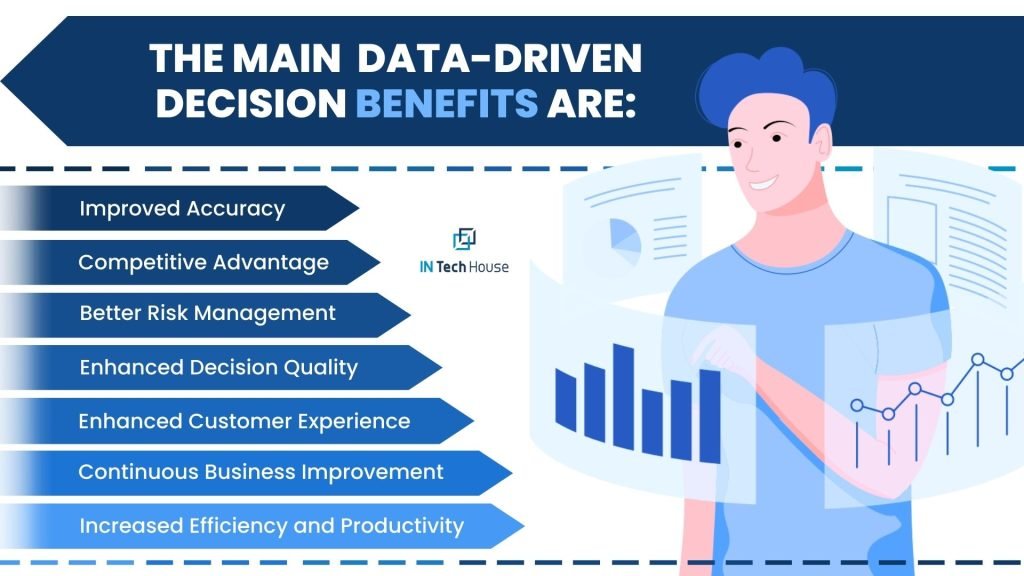
It enables unparalleled operational efficiency, unlocks deep customer insights that drive loyalty, and fosters a culture of innovation and agility. The companies that will lead their industries in the coming decade are not necessarily those with the most data, but those with the strongest discipline, ethics, and creativity in using it.
The question for your organization is no longer if you should embrace data-driven decision making, but how quickly and effectively you can begin.
Read more: AI Beyond the Hype: Identifying Secondary and Tertiary Winners in the US Market
Frequently Asked Questions (FAQ)
Q1: We’re a mid-sized company, not Amazon. Is a full “modern data stack” really necessary for us?
A: The principles are scalable. You don’t need to start with the most expensive tools. Many cloud platforms offer entry-level pricing. The key is the architecture: centralizing your key data sources, ensuring its quality, and providing user-friendly access for decision-makers. Starting with a single BI tool connected to your primary database (e.g., your CRM) is a perfectly valid and powerful first step.
Q2: How do we measure the ROI of becoming data-driven?
A: Tie your data initiatives directly to existing business KPIs. For example:
- Marketing: Customer Acquisition Cost (CAC), Return on Ad Spend (ROAS).
- Sales: Lead conversion rate, sales cycle length.
- Operations: Inventory turnover, machine downtime.
When you use data to improve one of these metrics, the ROI calculation becomes straightforward. The initial ROI is often seen in cost savings from increased efficiency before it manifests in top-line revenue growth.
Q3: What’s the difference between Business Intelligence (BI) and Data Science?
A: This is a crucial distinction.
- Business Intelligence (BI) is primarily concerned with descriptive analytics—answering “What happened?” and “Why did it happen?” It uses dashboards and reports to look at historical data.
- Data Science uses statistical modeling and machine learning for predictive analytics (“What will happen?”) and prescriptive analytics (“What should we do?”). BI tells you that sales dropped in the Midwest last quarter. Data Science can predict which customers are most likely to churn next month and prescribe the best intervention to prevent it.
Q4: How do we handle resistance from employees who are used to making decisions based on experience?
A: This is a common and sensitive challenge. Frame data as a tool to augment experience, not replace it. Encourage a “show me” culture. When an experienced manager has a hypothesis, suggest running a small, low-risk test to validate it with data. Often, when data confirms their intuition, it builds confidence. When it contradicts, frame it as a discovery that saves the company from a potential mistake, protecting the manager’s reputation and the company’s resources.
Q5: With increasing data privacy laws, is it becoming harder to be data-driven?
A: It’s becoming more regulated, not necessarily harder. The new privacy era forces companies to be more intentional, ethical, and transparent about their data practices. This builds long-term trust with customers. The key is “privacy-by-design” – baking data governance and compliance into the architecture of your data systems from the very beginning, rather than trying to bolt it on as an afterthought. This disciplined approach often results in cleaner, more reliable data overall.